


Archive

KHIA, KHI, Kunsthistorisches Institut, access registers I-XV, 1897-1968, film can (“pizza”) and microfilms, 1968 (?)

Historical Archive of the Kunsthistorisches Institut in Florenz

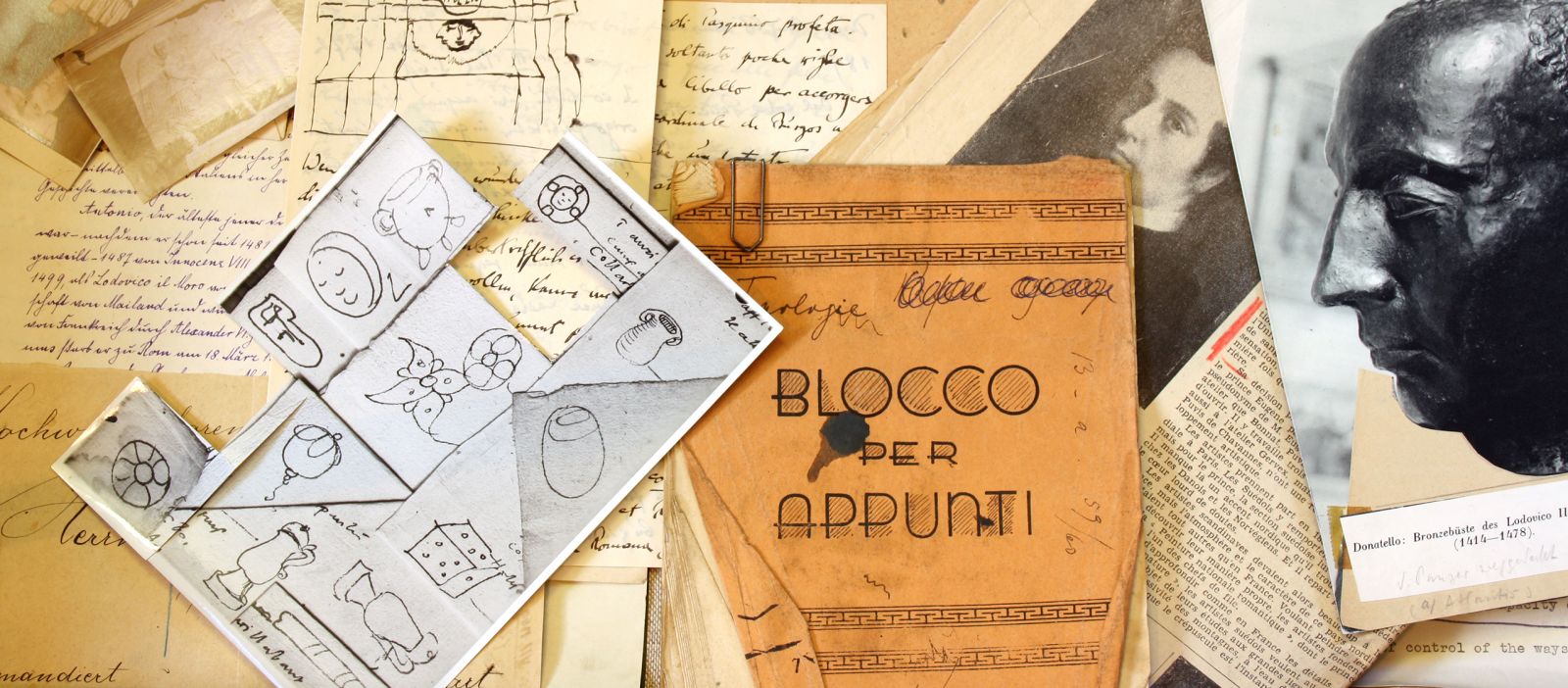
The Historical Archive of the Kunsthistorisches Institut in Florenz (reference code: KHIA) is the archive of one of the world’s oldest institutes for art-historical research. The materials held within constitute a documentary treasure trove on the theory and practice of art historical studies  – not only for the history of the KHI – and form a special archival chapter in the history of the city of Florence from the late 19th century to the early 2000s.

The KHIA currently houses more than 1500 storage units, containing a total of over 120 linear meters of records, and is organised into two sections: the institutional archive and bequests.

The cataloguing, creation and updating of finding aids, as well as the conservation and restoration work on KHIA documents, are ongoing activities and are carried out in support of the institute’s research and scientific projects.

Findbuch:
KHIA general index; level of description: storage units (see below)

Documents:
Kopierbücher, 1903-1912: volumes of copy letters sent by Heinrich Brockhaus, index of dates and recipients (see below)
Korrespondenz, 1910s-1920s: general institutional correspondence, index of dates, senders and recipients (in progress) 

KHIA, KHI Kopierbuch II, 1903-1905, sheet of tissue paper 6

The institutional archive (reference code: KHIA, KHI; 831 indexed storage units, 75 linear meters) consists mainly of correspondence. Exchanged between the institute’s departments and offices, and individuals and external institutions, the correspondence was collected and organised according to administrative practices, which are in turn documented in the materials and structure of the relevant sections of the KHIA. What appears to be a mixed filing system – by chronology, by author (directorates, assistants, office or relevant institutional body, location), and by thematic area (publications, Library, Photothek, activities, events, administration) – is now, in hindsight, an illustration of the dynamics of document production and collection, in this case copies of letters sent and letters received, along with their attachments.

KHIA, KHI, Palazzo Guadagni, clichés

The institutional archive also includes a wide range of materials such as albums and registers of varied nature (for example, address books, signature registers, visitor logbooks, expenditure records, acquisition records, and press reviews, some of which are also preserved on microfilm), activity reports (research and annual reports, sometimes integrated into correspondence, for example in draft versions) and documentation relating to the venues that have hosted collections, scholars and researchers, and KHI research (ranging from transparencies for restoration projects, to purchase or rental contracts, to sketches for furnishings).

KHIA, KHI, C, Studienkurs 1929, 10.79, invoices for photographic supplies

Throughout its history, the KHI has collected – and continues to collect – numerous bequests (299 indexed storage units; 29 linear metres), of varying sizes, from scholars with diverse connections to the history of the institute.

These fonds include collections of source materials and critical bibliographies, transcriptions of rare documents, notebooks, newspaper clippings, first drafts and drafts of published or unpublished works, sketches, correspondence, and institutional and personal documents.

KHIA, FAB, 13.7-9, Handschriften-Faksimiles, writing samples on tracing paper sheets

List of bequests

The general indexes for the bequests are available for consultation at the KHIA. 

  • Kurt Badt (reference code: KHIA, BAD; 4 storage units)
  • Walter Bombe (reference code: KHIA, BOM; 6 storage units)
  • Fabia Borroni (reference code: KHIA, BOR; 9 storage units)
  • Anton von Boschloo (reference code: KHIA, BOS; 1 storage unit)
  • Heinrich Brockhaus (reference code: KHIA, BRO; 11 storage units)
  • Werner Cohn (reference code: KHIA, COH; 6 storage units)
  • Alessandro Del Vita (reference code: KHIA, DVI; 1 storage unit)
  • Anton Dohn (reference code: KHIA, DOH; 4 storage units)
  • Gerhard Ewald (reference code: KHIA, EWA; 21 storage units)
  • Kornel von Fabriczy (reference code: KHIA, FAB; 1 storage unit)
  • John Gage (reference code: KHIA, GAG; 1 storage unit)
  • Max Goering (reference code: KHIA, GOE; 9 storage units)
  • Georg Gronau (reference code: KHIA, GRO; 9 storage units)
  • Detlef von Hadeln (reference code: KHIA, HAD; 1 storage unit)
  • Fritz Heinemann (reference code: KHIA, HEI; 3 storage units)
  • Ludwig Heydenreich (reference code: KHIA, HEY; 1 storage unit)
  • Georg Kaftal (reference code: KHIA, KAF)
  • Hubert Keutner (reference code: KHIA, KEU; 2 storage units)
  • Robert Klein (reference code: KHIA, KLE; 3 storage units)
  • Friedrich Kriegbaum (reference code: KHIA, KRG; 16 storage units)
  • Gustav Ludwig (reference code: KHIA, LUD; 47 storage units)
  • Ulrich Middeldorf (reference code: KHIA, MID; 24 storage units)
  • Ugo Ojetti (reference code: KHIA, OJE; 1 storage unit)
  • Walter Paatz (reference code: KHIA, PAA; 5 storage units)
  • Wilhelm Paeseler (reference code: KHIA, PAE; 1 storage unit)
  • Poggi (reference code: KHIA, POG; 2 storage units)
  • Klara Steinweg (reference code: KHIA, STE; 1 storage unit)
  • Henry Thode (reference code: KHIA, THO; 15 storage units)
  • Curt Weigelt (reference code: KHIA, WEI; 1 storage unit)

KHIA, KHI, examples of old storage units

User Information and Service

The KHI archive has been temporarily relocated to Palazzo Grifoni. Access will be limited during the summer months (15 June-15 September 2026). We apologise for any inconvenience.

The KHIA is accessible by appointment only from Tuesday to Thursday, 11 a.m. to 5 p.m. Researchers interested in visiting the KHIA are kindly required to obtain a KHI user ID card and to book their visit in advance.

The finding aids of the institutional archive and bequests are under revision. The general indexes for the bequests are available for consultation at the KHIA. Preliminary requests can be addressed to the contact below. Access to documents is only granted after verification and with the assistance of KHIA staff.

For reproduction and publication of documents, permission must be obtained from the KHI directorates. Publications or unpublished derivative research (Degree or Doctoral Theses) must be deposited respectively in duplicate and on file at the KHIA.

The KHIA staff cannot guarantee availability for commissioned research or the reproduction of materials for remote consultation and therefore reserve the right to carry out such work at their discretion, depending on the timetable of ongoing activities.


Contact

archive@khi.fi.it

Newsletter

Our Newsletter provides you with free information on events, tenders, exhibitions and recent publications from the Kunsthistorisches Institut in Florenz.

If you would like to receive our newsletter, please enter your name and e-mail address:

*required field

Notes on the content of the newsletter and transit procedures

This letter is sent via MailChimp, where your e-mail address and name will be saved for sending the newsletter.

Once you have completed the form, you will receive a "Double-Opt-In-E-Mail," in which you are asked to confirm your registration. You can cancel your subscription to the Newsletter at any time ("Opt-out"). You will find an unsubscribe link in every Newsletter and in the Double-Opt-in-E-Mail.

You will receive detailed information about transit procedures and your withdrawal options in our privacy policy.